Extra Life Triathlon Fitness

This blog has moved to www.extralifetrifit.com. Extra Life Triathlon Fitness is a coaching service to help people achieve exceptional fitness, joy, and fulfillment in the sport of triathlon. Join us today!

Sunday, December 22, 2013

Next Steps - A Christmas and New Years Message

Christmas in Salt Lake City. A winter wonderland

As I mentioned in a previous post, I always love this time of year. The lights, the crisp air, the generally more pleasant attitude coming from everyone (while there may be some exceptions of course). The culmination of the holiday season, Christmas Day, is not necessarily my favorite day of the season. More so is the lead up to Christmas, when goodwill is at the forefront of our minds, and we are more frequently aware of the grace we are offered by God. At least this is true for me, especially in more recent years. Giving gifts is great, but it's the empowerment of the soul and the rejuvenation of the spirit which make this holiday special. As the Grinch himself expressed:

"'Maybe Christmas,' he thought, 'doesn't come from a store.
'Maybe Christmas... perhaps... means a little bit more!'"

We've all heard pontifications on "the True Meaning of Christmas", so I won't wax on. However, I will say that it is fitting that Christmas falls at the very end of the calendar year. If we choose it to be, we can make it a celebration for the blessings we have received over the course of the year. A chance to reflect on what we have achieved, and prepare our positive attitudes for blessings to come in the next year, beginning a week later.

I, myself have been profoundly blessed. Blessed to have a wonderful family, blessed to have another year of sobriety, blessed to be healthy, blessed to be motivated to perform at my absolute best, and blessed to have been given the opportunity to set an example for others, including my family.

Early in 2013 I was struck with an insane, uncharacteristic, and seemingly impossible idea. With my arm in a sling, and a gut hanging over my sweat pants, I somehow had the motivation to do an Ironman triathlon. Somewhat of a "New Year's Resolution". I had never swam any significant distance, didn't own a bike, let alone know how to ride a road bike, and the chronic abuse of my lungs and liver made the idea of participating in any endurance sport a laughable proposition. However, the idea struck me with such force that I had no doubt that I would achieve it, and I went about planning for success.

A few months ago I wrote an article in for MindBodyGreen called Stop Abandoning Your Goals! In it I advised people to set smaller, more easily achievable goals as milestones to the greater goal. That would make the greater goal more easily achievable. This was part of my "success plan", to create incremental goals leading to the bigger one. I signed up for Ironman Los Cabos set to take place on March 30, 2014, and then signed up for a number of shorter triathlons leading up to that date. Sure enough, eating a healthy diet and following a strict training plan, I was able to complete two sprint triathlons during the summer, where I was able to gain confidence in open water swimming, and get a feel for the race. Then I finished an Olympic distance triathlon, to get used to racing for multiple hours. Finally, a couple weeks ago, I completed a half Ironman. A far cry from the injured and unhealthy person dreaming at the beginning of the year.

So now after completing those distances, while still a significant challenge, the actual Ironman triathlon does not seem as formidable. It is just the next step. And with three months to go before the race, it's the final stretch of training, so it's getting real.

I know that was a long way from the original message of this post, but it brings us around from reflecting on the past year to how we can look forward to the next. I will no longer look forward to unfulfilled dreams and empty promises. I will continue to dream big and create a road map for achievement.

So this year, as you consider your New Year's resolutions, consider this. Dream big this year. Despite what you tell yourself, you can achieve it. To get there, just take the next step. Set smaller goals to propel you forward. Finally, have a very Merry Christmas, reminiscing on the blessings of the previous year. And may God grace you with a prosperous and dream-fulfilling New Year!

Tuesday, December 17, 2013

2013 HITS Triathlon Race Report - Half Ironman

Lake Cahuilla, where the swim would take place
My first impression upon signing up for the HITS Half Ironman Triathlon was that, as a first exposure to real distance, this was going to be about as easy as it could get. The desert is pancake flat (which means no extra energy required to power over hills), the bike course was straight with only a few turns, and in previous years the field had been small. Needless to say, as other challenging factors came into play, my initial impressions became more and more inaccurate.

Overall I was not disappointed with this race at all. For the price of admission (which is significantly less than other similar distance triathlons), we enjoyed a fantastic race, and a great first experience with this distance which left me wanting to do this distance again... maybe after a bit of rest. To be honest, I wasn't expecting much. Many of the reports I read from previous years described it as limited in support, with few aid stations, little direction, and sparse porta-potties, but for the most part they received a positive reaction. Besides, I'm relatively low maintenance when it comes to these events, so I didn't need much in the way of frills.

The week leading up to the race I had a couple of priorities. The first was to avoid getting sick at all costs. 'Tis the season to be fluey, and I did my best to quarantine myself from kids and coworkers had any symptoms of nasty things, and thoroughly bathe myself in sanitizer. Second, I checked the weather report every day, and every day the outlook looked more ominous. Apparently, Canada was attacking the United States with arctic air, and the desert was not safe. At the beginning of December, Palm Springs could be either 80 degrees during the day or 50 degrees during the day. I had planned for the former but it became apparent that it would be the latter. This was the first indication that it may not be as easy as I expected.

We arrived the day before the race to attend the expo and packet pickup, and I caught the pre-race meeting. Apparently, the half was sold out (550 participants), and the full was nearly 200 athletes. This was bigger than previous years from what I had heard. Further more, they would be tightening up the swim course to be very close to shore and two laps (four for the full). This would make the swim very crowded. The second indication that this may be more challenging than I expected. We checked into our room at the Embassy Suites, and were immediately upgraded to a condo, which was great because we now had a kitchen, and didn't have to go to a restaurant to eat. We would be able to go to the store and have control over our pre-race meal. That's exactly what we did, and I had my typical eggs, rice, and black beans, plus an apple and almond butter for dessert. Then it was off to bed to stare at the ceiling fan for a few hours before heading off to the race.

Transition Area
I arrived at the race venue around 5 am and set up my gear and get a good warm up before the race. The transition area is truly fantastic, with our own large area and stool. No chance for interference by other people's equipment, knocking bikes over, etc. It was cold during setup, below 40 degrees, and a lot of spaces remained empty which meant there may be a sizable DNS (did not start) rate.

After I set everything up, I got my wetsuit on and ventured down to the water. after taking my socks off, my feet went numb. Walking down, I could feel sharp pebbles on my feet only by the inconsistency in my balance. I was just hoping that I didn't rip my feet open before the race start. Even though the water was in the 50s, it helped my feet warm up a bit, but submerging my head gave me an imediate ice cream headache which lasted the entire warm up. I had trouble keeping my face submerged for any significant amount of time, and I worried that I wouldn't be able to swim effectively. However, after about 10-15 minutes, I became used to the water (only to have to get out for about 10 prior to race start). 

Swim:

The swim start was a bit unorganized, as I didn't hear any signal to start, but people just started swimming. I was caught sort of in the back of the start pack, which was a bit unfortunate because the first leg of the swim was very narrow, and everyone bottlenecked into about a 15-20 yard lane between the shore and the buoy markers (about 5-10 yards of which were 3 feet or less of water). I was not able to make much headway or pass anyone during the first 500 yards of the race, and had to settle for floating down what could only be described as a chaotic "lazy river" of thrashing arms and legs. A good portion of the field was literally walking the first 1/4 of the race, which was entertaining to watch. Finally around the far buoy it opened up a little bit, but it was still quite congested. Due to restrictions with water craft in this lake, they were forced to squeeze 500 athletes through the narrow lanes for two laps (4 laps for the full). I had no open water or ability to pass until the last 3/4 of the swim. Even though my swim was slow, the bright side is I was very fresh for the bike and run (although very cold).

Running out of the water, I was able to see my family (parents, wife, sister, & brother in law). While I tried to look heroic, I was trying to run on cold legs, and ended up instead nearly falling over a woman who was picking up her goggles. I proceeded to run up the grass to the transition area once again feeling the sensation of rocks poking through my feet.


Swim Time: 38:27, 181st out of water

Transition 1:

I had planned on fully changing clothes during the first transition so that I could be warm and dry, thus I knew I would take a bit more time than usual. I figured everyone else would be doing the same, and I wasn't wrong. I also knew that this would cost me more time, perhaps a few more seconds while I threw on an extra couple layers and gloves. What I failed to anticipate was the effect of the cold on my body at that point. Getting out of the water I was mostly numb, and if anybody has ever tried practicing dexterity in the cold, you know how difficult it can be. I felt like I was trying to guide someone else's hands, and they weren't being very cooperative. When I arrived, I saw another person already sitting in transition next to me. My feeling was that as long as I could get out before him I would be okay. Nearly 7 minutes, and three layers of clothing later, and I had achieved my small goal of getting out before him.

T1 Time: 6:39

Bike

One thing that I was worried about, especially since my experience in Oceanside, was that I would become too cold on the bike. I have been doing whatever I can to acclimate to heat given my Ironman attempt in March, so I am not very well prepared for cold. The only other thing I was concerned for was the wind. It was expected that at some point during the day (likely the afternoon) the winds would pick up to 20 mph+. Fortunately, my wardrobe plan was successful and I was only numb in my feet. Gradually, however, my feeling came back even there and I don't recall ever being uncomfortable on the bike. Now it was up to my fitness and my nutrition to take over so that I could win the race against the weather turning bad.

For my nutrition I was going to keep it very simple: a blend of sugars and salts mixed into my aero drink to the tune of about 1400 calories. That was calculated for a three hour bike, and was more than the typical 400 calories I usually take in (but I figured I would be exerting more energy over the course of the ride). In retrospect, I think it was a bit too much, but at least it wasn't too little.

I felt great on the bike. Early on there was no significant wind, and the weather was nice. I was so far back on the swim that I didn't get passed at all on the bike. In fact, I must have passed 100 to 120 people. The course was flat and straight, so it was fairly easy to gauge my output. My heart rate stayed just around the mid 140's, unless I had passed someone, but never ventured past 150 or so. At only one point did I have to slow down significantly because a big-rig was on the road and was unwilling to pass the other racers. I don't blame him, of course, as it could be a very dangerous situation. Fortunately this only lasted a couple minutes and I was back to race pace. The only other time I slowed briefly was to pee. This was the first time I have peed on the bike in a race, and I'm abnormally proud that I could pull it off without shame. I will say that it will be much easier when hills play a role, as I had to keep pedaling a bit to keep momentum up.

As I approached the last turn back toward transition, it was at that point I could feel the wind starting to pick up. It slowed me down a bit, but I was able to climb into transition successfully and at a personal best for that distance.

Bike Time: 2:36:25; 21.54 mph avg.; 26th/394

Transition 2

T2 was relatively uneventful. I got in there and changed my shirt, put on my fuel belt, hat, and shoes and was on my way. I took a quick pit stop at the porta potty (since peeing while running is something I have not yet mastered, nor will I ever), which proved unfortunate for the person coming up behind me. Since there was only one at the exit, he had to wait for me.

T2 Time: 3:07

Run

Immediately when I got on my feet I began to feel the effects of taking in too many calories on the bike. Nutrition is a balance in any race: Take in too little and you risk falling apart. Take in too much and you risk significant gastro-intestinal problems. I was subject to the latter. I could already feel the cramping coming on, and I didn't feel much like drinking any more. Unfortunately, water would still be required on the run. I heavily considered puking during the first part of the run to open up some room, but decided against it as long as I could hold up sub 8 minute miles.

That I did for most of the run. My ultimate goal was to run 7:30 for the full half marathon, and I was successful for the first few miles. At that point I started feeling a bit fatigued and had a couple miles over 8. At the turnaround, I began feeling better and started resuming my earlier pace. I had a quick realization during the run that my bike fitness was much better than my run fitness, as I was immediately passed by a few very fast runners. However, toward the second half of the run I began passing quite a few people (I think I picked up 10-15 spots on the run).

Down the road I could see the stoplight where we would make the turn toward the finish and I began to push my pace a bit. I was about to finish 70.3 miles of triathlon for the very first time, and cross one more milestone toward 140.6. My goal was to go sub 5 hours, and I didn't know where I was at at this point and I didn't much care. I just wanted to finish, and was happy that I was about to.

Arriving at the stoplight I had a horrible realization. The final turn toward the finish was not at a stoplight, it was at a stop sign. I had an extra half mile to go before I made that turn (and then about a mile after that). Already a bit demoralized, I saw a big wall of dust in front of me which seemed to be travelling very quickly to the East. The wind had arrived just in time for my race finish. As I rounded the corner toward the last mile and a half of race I headed directly into the wind, which was gusting at over 20 mph. Looking to my left I realized how good my situation was. Some people were just finishing the bike. Others who were doing the full triathlon, had hours of biking left to go, and then a marathon. Remembering that it's all about perspective and keeping things positive, I put my head down and pushed on. It was time to finish strong.


Just after noon, I crossed the finish line. Official time was 5:04:36. While I didn't beat 5 hours, I came pretty dang close, and I had a fantastic race. Taking into consideration that it was exceptionally cold and a bit windy, I'm happy with the result. It was good enough for 7th in my age group (out of 43), and 32nd overall (out of 394). Additionally, I beat my personal best half marathon by over 10 minutes, even with the cramping, wind, and cold.

Run Time: 1:39:56; 7:38/mile; 35th/394 for the run

Overall I'm ecstatic about finishing this race. Regardless of the time it took to do it (and about 5 hours is pretty good), I was able to successfully complete the distance; 1.2 miles of swimming, 56 miles of biking, and 13.1 miles of running. A more miraculous feat came from the 73 athletes who completed the full Iron distance triathlon that day. The DNF rate was likely greater than 50%, as heavy winds hit right at the halfway point. They would also race into the night where temperatures would drop into the 40s. Putting this into perspective, I started at the same time as them (7 am), finished at about noon, hung around for about an hour, drove 140 miles to get home (stopping for lunch), had a long bath, got dressed, drove to Anaheim for a company Christmas party, drove back home, and went to bed. As I lay in bed, having no trouble falling asleep, people were still on the course finishing the full.

Right after I finished the race, my Mom asked me if I was ready to do a full. At that moment thinking about doing a full made the contents of my stomach want to take a trip upward and outward. However, it really is about mental preparation. I was thoroughly prepared for a 70.3 this day, and mentally I was conditioned for it. In a little over 3 months time, I will be thoroughly prepared for 140.6, and I will spend the majority of that time mentally conditioning myself for that. Ask me again in three months. I'll be ready.

It's been a little over a week now and it's settling in exactly what was accomplished. Less than a year ago I couldn't bike, could barely swim a few laps, and hadn't run much in the previous year. A few months of training later and I've completed a half Ironman. Next stop, Los Cabos. But first, a couple weeks of rest until Christmas, and then the buildup begins.


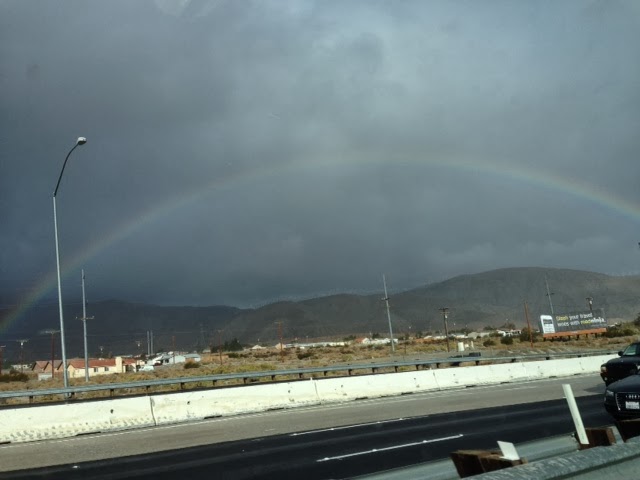
On the drive home we saw a full rainbow... in the desert. It was raining hard and the wind was blowing hard. In about a half hour this weather would reach La Qunita where it would hit athletes doing the full.


Sunday, December 1, 2013

Taper to First "A" Race - HITS Palm Springs Half Iron Triathlon

We're a little less than a week out from my last race of the season, which I have considered my "A" race - the race I have trained for this season. It is strange to think of this as a primary race, when I still consider it a warm up to the full Ironman in Cabo San Lucas. It is also strange to think of this as the last race of the season when it is only three and a half months until my next "A" race. However, it helps me to think that there is a break between the two so I can catch my breath and get ready for some more intense training volume.


While these things are strange to me, it is also fitting that The HITS Palm Springs Half Iron Triathlon be an "A" race, as it is my first attempt at this distance (half a full Ironman, at 1.2 mile swim, 56 mile bike, and a half marathon). It also happens at the beginning of December, right before Christmas, at which time I fully intend to briefly break away from my strict diet and indulge in the culinary delights of the holidays, including Christmas cookies, chocolate, and figgy pudding (whatever the heck that is, but I'm sure not leaving until I get some!). Moderation is key, of course, and as soon as Santa tucks himself in for his long Winter nap, I'll be back on course for my plan leading up to Cabo.

But back to this race. With less than one week to go, I am in full taper mode, and have been for about a week and a half now. I did a bit of a warm up at about the same distance on Thanksgiving day and felt really good. I can say at this point, barring any sickness or injury between now and then, that I am completely ready for this event.

The swim will take place in a reservoir, which will be a new experience for me since I've never swam in anyone's drinking water before. It's also quite possible that the water can be very cold. Last year it was in the high 50's. The bike and run will be very flat and at or below sea level, so it should be relatively easy to pace. The only challenges are that the weather and wind can be unpredictable. In the desert it could be very cold or very hot. I've planned for very hot, because I can always add layers if it gets cold. When the weather changes, so to does the wind, and it could be pretty brutal. We'll see how it shakes out.

It's amazing to think that after I finish this race, I am only a few short months away for the main event of this journey that I began almost a year ago. To think of where I came from and where I am now is amazing. I look forward to posting a race report next week, and beginning the next leg of this journey. Until then.

Monday, November 25, 2013

Gratitude!

Leading up to Thanksgiving, many people begin to talk about what they are thankful for. While it may seem cliche, I wanted to talk about what I am grateful for in my life. It seems that during the holidays many people force themselves to express what they are thankful for. But should we really have to force gratitude? Furthermore, why should we confine our expression of gratitude to just one holiday? Gratitude should be something we focus on year round. In fact, I try not save this gratitude for one day out of the year, I try to focus on it every day. It's how I start and end my day.


One of the reasons I love the holiday season is because, starting in mid-November, people begin to prime themselves with the mindset of thankfulness. That collectively changes the mentality and compounds the effects of positive thinking. If you're willing, it's easy to cultivate a positive attitude during the holidays through gratitude (again, if you're willing). The challenge is making this attitude of gratitude last throughout the year.
One of the hardest things for me to do during the day is wake up (or be woken up) and leave the peaceful comfort of the bed with a positive attitude. I don't care how hard I try, I will never wake up with an immediate spring in my step and cartoon bluebirds singing on my shoulder. Instead my first desire becomes to through my alarm clock through the first solid object I see and get back to bed. However, with that attitude present first thing in the morning, it begins an upward battle to change my perspective on what the rest of the day will bring. One of the ways I thwart this and reinforce a positive attitude for the day is to immediately begin listing ways in which I am grateful, either in prayer or meditation. I try to visualize clearly this gratitude as it enters my mind, thus drowning out any negativity or clutter that may exist. It's always beneficial to revisit this list once more before bed time. 
Unfortunately, while a lot of gratitude exists around the holidays, so too does negativity and stress. But don't be absorbed by negativity, instead be the tip of the spear for gratitude! If you actively practice gratitude daily and cultivate a positive attitude, you will find yourself attracting the positive and blocking the negative. Furthermore, you can bring a little holiday joy to the rest of the world all year long. 
There is no doubt that a positive attitude is contagious, and there is no better way to spread good will than to lift up other people in your life. So with that in mind, I'll share my "top 10" gratitude list with hopes that some of it may rub off!.

I am grateful for...

1. My family and friends, who have supported me immensely despite my insanity. The number of people in my life who say "go for it!" far outweigh, and therefore drown out, the people who say "you can't".
2. My wife who, in addition to practicing what's listed in #1, will additionally kick my butt into gear and find new ways to encourage me and others.
3. My kids who inspire me much more than I would hope to inspire them.
4. The fact that unhealthy obsessions and compulsions - such as drinking, smoking, or eating copious amounts of refined sugar - are no longer with me, and that today I can enjoy life without these things much more than I did with them. 
5. God's grace. There is no doubt that today I live in unmerited favor. On a daily basis I want to do my best to glorify Him rather than myself.
6. My willingness to seek out the positive and inspiring rather than be consumed by the negative. 
7. Freedom.
8. The ability to provide a warm, safe environment for my family.
9. That I have the opportunity to practice a healthy lifestyle on a body which I had previously squandered. I am fortunate to be able to find absolute joy and peace in discovering fitness and health.
10. That today I am relieved of anxiety, depression, and discouragement.

Additionally, I am grateful to all of you who have taken the time to follow me here and read this little blog. I enjoy doing it, and hearing the feedback. Have a very happy and grateful Thanksgiving!


Thursday, October 31, 2013

Smile

Image by Larry Maurer
This is Chrissie Wellington. Yes, she's smiling. She hasn't won (yet). Heck, she hasn't even finished. She's still on the bike, which tells us she's somewhere between a 2.4 mile swim and a full marathon. Not a lot of people would be smiling at that point! It seems to me that she is aware of something very important that a lot of people ignore; it is just as important to enjoy the journey, not just the finish. This understanding is clearly reflected in her attitude, and she wears it proudly on her face in the form of a smile.

Wellington ended up winning the Ironman World Championships 4 times, and held world records for her finish times (and likely world records for smiling in some capacity).

At some point during the process of taking a dramatic leap into a personal challenge, the enthusiasm begins to wane just as our perception of the difficulty of the challenge becomes more apparent. The exercise of working toward a goal becomes mundane, and we struggle to find motivation, to wake up early, to put in the required work, or even remember why it is we are pursuing this goal in the first place. We forget to smile through the journey, and our results and motivation suffer.

I have found myself in this very spot recently. Training has become more difficult, as I begin to get into more speed work, longer swims, and earlier mornings. I found I was just going through the motions, but not becoming very motivated. I needed to step back and remember why I am working so hard. I want to set an example. To show that great joy can be found by honestly sharing your story and being in service to others. That joy can also be found in challenging yourself and following through. Yes, the training is hard work, but it is necessary work to experience the joy of the accomplishment. And joy is worth smiling about.

I decided to do just that this past weekend during my long run. I would try to maintain a smile for the entire 2 hour run, and see how I felt during and after. First thoughts? I felt absolutely ridiculous. I knew that everyone would be looking at me and wondering why this creepo had a wild ear to ear smile on his face. Further, it felt forced. It's not easy to smile while you're working out. That is serious business, of course!

However, as I drove on and kept forcing that smile, something magical began to happen. I began feeling a new level of joy with what I was doing. I naturally began thinking positive thoughts, rather than the typical thoughts I have, such as "I wish my pace were better," or "man, am I tired!". Gratitude began to naturally sink in, and I just felt thankful that I could be out on safe road on a sunny day with two working legs. The people I thought would be looking at me as creepy instead smiled back and often waved hello. The smile became part of my attitude, and was clearly affecting others as well. It was truly therapeutic. Ms. Wellington is definitely on to something!

That long run became my longest to date, at a little over 16 miles, and my pace was much better than expected. I ran this experiment on my next two runs as well, and one of them became my fastest hill workout. Likely this was a coincidence, as I don't think smiling actually made me faster, but I do think it affects performance to some extent, as well as ongoing attitude. Exercise could be a form of meditation, and if you are happy and at peace during meditation, that peace continues throughout the day. At the very least I find myself feeling more joyful and positive throughout the day. I am also confident that over time I will be able to perform better because the attitude is already shaped toward success.

I have talked about how listening to your body is important to physical and mental fitness. If you monitor your heart rate you can have more success at burning fat, becoming more fit, and becoming healthier. I now believe that a smile can be the return feedback you are giving your body. When you smile, you may just be telling your body "I am enjoying this activity and the results it offers. Let's keep it up!" You're body will abide.

Upon seeing Chrissie Wellington smiling during an Ironman race for the first time, I thought she must be crazy. Now I think I get it, and I'm buying what she's selling. I would highly recommend to anyone, in an effort to reinvigorate your activities and bring life back into your passion, to force a smile. I am confident that eventually it will become natural, when you once again begin to experience the joy of your accomplishments.

Until next time, have a nice day!


Monday, October 28, 2013

Oceanside Triathlon Race Report

It's taken me a good part of this week to defrost my body and brain after the Oceanside Triathlon, so I haven't had a chance until now to actually write a race report. I do have to say though that the recovery period at the beginning of this week was very welcome, especially after a very competitive and frigid race. Yes, the extended warm summer ended just in time for this race, and the result was an eerie, cold, and somewhat sketchy (by no fault of the race directors, but I'll get into that).

There are some pros and cons to doing an inaugural race, the pros being that they may typically be less crowded. That was the case this day, as only about 250 age groupers were racing. This would give us a lot of room to run our own race. The cons include poor preparedness, lack of knowledge of the course, and general first year glitches. This was not the case with Lifetime Tri, as they put on a great show with great support, and it seemed like they had been running this race for years.

The one thing I noticed immediately while getting ready in transition was the incredible amount of fitness everyone had. There were some very serious athletes in this group of 250, and it was sure to be a very competitive race. I was becoming worried that I may finish last in this race, but then I reminded myself that it didn't really matter. I was here to race for myself and beat my own expectations, which at this point was break 2:30 and feel happy with the effort.

I was well aware that the morning would be cold, and it didn't disappoint. As we readied ourselves in T2, the temperature read 48 degrees. However, once the sun rises it is anyone's guess as to how the temperature will swing. It could heat up dramatically, it could stay cool, or we could be buried in a cold, soggy layer of fog. As the sun rose and the pros started their race, it appeared we were in the clear and we would have a sunny race.

Swim Start Oceanside Triathlon. Courtesy of Lifetime Tri

Swim

After the pros and the elites were on their way and racing for $50,000, it was our turn to get in the water. The swim followed the same route as the Ironman 70.3 Oceanside  Triathlon, which takes place in the Oceanside harbor, going down the channel and back toward the boat launch. Unfortunately, we weren't allowed a warm up in the water because of the general "corral" type of swim entrance, which was concerning to me. It always takes me a few minutes to get comfortable swimming in the open water, and a warm up would have helped me to start my race in a good place. Fortunately, the water was a comfortable 65 degrees and I decided to take it slow at the beginning and warm up that way. I figured everyone else was doing the same thing. 

No sooner than we got in the water did a blanket of thick fog begin to sit on us. We had no sights on the buoys, and thus no point of reference with which direction to swim. Once the horn went off, we all just started swimming in the general direction we thought we needed to go. The race got an eerie start, and I was going on faith that the swimmers in front of me were going in the right direction. Occasionally we would pass a lifeguard who was pointing in the direction we were going, but how could we be sure that they knew where they were directing us? Perhaps they were just pointing in that direction because we happened to be going that way. If this swim was in the open ocean I would be worried, but we were in a harbor, so we were bound to bounce off of something eventually if we got lost. 

I was able to draft off of the lead group for about 2/3 of the race, which served two purposes. First, it conserved my energy and helped me to go faster, and second, it helped me to use them as my eyes. Occasionally I would hear one of them say "which way are we going?", but I'd let them figure it out and continue drafting. The strange thing about swimming in heavy fog without any sighting is that you have no clue how far you have swam and how far you have yet to go. You just keep swimming until someone points you around a turn buoy. I had never known until this point how beneficial it is mentally to actually have points of reference, otherwise you feel like you're going nowhere!

During the final stretch I lost the feet of the group ahead of me and they pulled away rather quickly at that point. I then discovered that I was leading my own pack of swimmers who was drafting off of me. That was a first!

As I exited the water, I felt happy to be done with the swim, but still felt very disoriented, and thus forgot to take my wetsuit down to my waist (which lost me a lot of time in transition). At this point I had no idea where I stood in placement, so I was rushing quite a bit. I would learn later that I was 7th out of the water in my age group (out of 25).

Official Swim Time - 28:36 (1:45/100 yds)*
* My Garmin measured the distance at exactly one mile, which is longer than 1500 meters

Transition 1

Out of the water and up a boat launch ramp. I was able to take my goggles and cap off, but completely forgot to take down my wetsuit. As I reached my bike, I realized my error and started frantically peeling it away. It's always tough to get it over my wrist watch, which cost my precious extra seconds. By the time I got my wetsuit off I was disoriented and trying to remember what needed to be done next. I finally got my nutrition in my pockets, helmet on, and then I remembered to put everything in my wet bag (to be brought back to transition 2 after the race). I looked at my arm warmers and thought to myself that I better save the time and keep them off. Big mistake! I threw them into my wet bag and went on my way.

Time - 3:14... Ouch!

Bike


Photo courtesy of Lifetime Tri
This is about what it looked like exiting T1, into a thick layer of fog which became worse as we got onto the highway. We were warned that the beginning part of this race was bumpy with some precarious turns leading out to Highway 76, so we were advised not to start racing until we reached the highway. I followed that advice, and as a result was passed by a few people on the way out. But we had 25 miles to go, so I was fine with that. 

A few turns to get out of the harbor, and then onto PCH for about a quarter mile, then a left turn onto the highway were I would spend the next hour or so battling cold and fog. The initial part of the bike I was comfortable, and not terribly cold, but as I started to pick up speed it was clear the cold air was going to be painful. The air itself was not necessarily cold, but the condensation in the air would stick to my skin and form little droplets all over my exposed arms, legs, and face which, when hit by 20 mph steady winds, would freeze the skin. "Oh well," I thought. Everyone else was dressed the same way as me, but the faster we would go, the more we would be punished. Now it became a battle of who could withstand the most pain.

As far as my pace, it felt effortless, and I wasn't nearly exceeding my race heart rate. In fact, the strain I was feeling was directly related to the cold, and not my effort, which was a strange sensation - the feeling that I could easily go harder but my muscles weren't cooperating as well as they otherwise would have. Once on the highway I was averaging about 22-23 miles per hour, and I was passing a number of racers. Also, I was being passed by a number of pros going into their second lap. This was a clear demonstration of the fitness gap between pro and amateur in this sport.

The second lap became a lot more crowded, and I was a lot more cold, so I decided to settle in behind a group of racers that were going about my speed. Rather than pass them and use up excess energy, I decided to conserve it for the run and defrost a little. Besides, getting out in front in the fog is not a preferred position. If a rider went down ahead of us, we wouldn't be able to see it in time to stop. Back onto PCH and into the pier area, I was happy to be off the bike and ready for a run.

Time - 1:08:55, 4th place in age group
Avg Speed - 21.6 mph
Garmin profile - http://connect.garmin.com/activity/393348542
Nutrition - 250 calories of Carbo Pro plus 2 homemade oat/honey/almond butter clusters.

Transition 2

I had more trouble in T2 because my fingers were numb, and I couldn't easily grab things or put my shoes on. Finally did, and was out on the run course.

Time - 1:47

Run

My goal on the run was to do my sprint pace at the Olympic distance. This would come out to about a 7 minute mile, a pace that has proven just out of reach in recent races. Unfortunately, nature called at the beginning of the run, and I had to hit the porta potty. I still haven't been able to bring myself to pee on the bike, which will become necessary as I get into the longer distances. This is more of a psychological issue than anything, as we spend our whole lives doing everything we can not to pee on ourselves. This is one of those rare exceptions which is made worse by the fact that you are working at an increased intensity.

Quick 20 seconds in the bathroom and I was off again. I was still having strange sensations while running, due to being numb all over, but not necessarily being tired. I kept trying to push through and warm myself up. Soon I was having a few GI issues. Again, I just powered through and kept going.

The course was mostly flat, but mixed in were a few short, killer hills. The strand connects to Pacific Avenue via a very steep climb, which was really challenging. Once I ran up the hill for the last time, I hit the gas and started running sub 7 miles. I felt great going into the finish and was able to finish in a full sprint. While my pace wasn't what I wanted it to be, I felt that I did my best given the conditions.

Time - 45:18
Pace - 7:18/mile

Conclusion

Total Time - 2:27:51
Place - 7th Age Group (30-34 out of 25), 58th overall (out of 232)

I am absolutely happy with my finish at this first Olympic distance effort. My goal was to finish in under 2.5 hours, and I did so in 2:27. After less than a year of putting in smart exercise and healthy diet, I have been able to maintain a front of pack performance on a 2.5 hour triathlon. When I think back to when I started training back in February, and how weak, slow, and unfit I was, I am amazed with the improvements I have made. My pace back then was just under 12 minute miles, yet I was patient and gradually it improved. I am now more motivated than ever to keep training for the longer distances.

Speaking of longer distances, I now head into the more "ultra" range of triathlon. My next race is a half Ironman distance in Palm Springs in December, the HITS Triathlon. After that race, I will be preparing for the full Ironman in March. Things are getting real now. We are only a few short months away, and we are getting into some long distance now. I am actually looking forward to that, as I want to be at the more steady paces, not the fast paces I have been at. I'm ready to show that I can pace myself and do the distance.

As I mentioned, Lifetime put on a great show, and I would love to do another one of their events in the future. Within a few minutes of the race finishing, the sun finally came out and it became a beautiful day.


Tuesday, October 15, 2013

Oceanside Triathlon Pre-Race

Ah... the wonder of the pre-race taper. There is no greater joy than building up to high volume workouts of 20+ hour weeks only to taper off leading up to a race. To look at your workout schedule and see a single easy workout followed by a day of rest is a thing of beauty. Many people ignore the taper and go hard through to the day of the race. Others feel uncomfortable significantly backing off their workouts for fear that they won't be race ready.

Oh, but not I. I fully embrace the taper. It may be the subdued lazy ass in me, but after weeks of heavy volume, I am fully willing to take a few rest days. I am running on faith that allowing the body and mind to rest will give me fresher legs for the race. I firmly believe that rest is just as important as work when it comes to proper training. It is truly about finding that balance.

With the Oceanside Triathlon coming up this weekend, I am in the middle of my first taper since I began training. This one is somewhat of a "mini" taper, as it only lasts a week (I will do a full 3 week taper leading up to my half iron distance in December). Once again, I am keeping my expectations low for this race, as it is my first olympic distance triathlon (1500 meter swim, 25 mile bike, and 6.2 mile run). I have no doubt I can do the distance, but it's about how I pace it, and that's what I want to practice. For me this will be a trial run toward the longer distances in how I manage my pacing, my nutrition, and my patience. I plan to employ my plan from Long beach, which is to go out hard on the swim, conservative on the bike, and then as hard as I can on the run. If I can still be fresh after the swim and bike to run a good 10K I will know my fitness is good enough to handle a half Ironman.

This should be a fun race, and I'm glad I found out about it. Being that it is an inaugural event, there may be some organization issues, but it's being put on by Lifetime Sports, which is hosting this as the championship event for their triple crown. Since it's the first year they are hosting it, it's hard to know what to expect. Will it be challenging? How many competitors will there be? How is the support? I will have to be open minded about this one.

If you'd like to come down and check it out, we will be starting out at Oceanside Harbor at around 7 am, and we'll be finishing at the Oceanside Pier by around 9-10 am.