Extra Life Triathlon Fitness

This blog has moved to www.extralifetrifit.com. Extra Life Triathlon Fitness is a coaching service to help people achieve exceptional fitness, joy, and fulfillment in the sport of triathlon. Join us today!

Friday, February 28, 2014

Running Scared

A year ago, when I waved the forefinger of my one good arm in the air and proclaimed confidently to the heavens that "I would complete an Ironman", a year was a long way off. So far off in fact, that I needn't let March 30, 2014 worry me at all. It was a lifetime away, and certainly enough time to be adequately prepared to survive a 2.4 mile swim, 112 mile bike, and 26 mile run. My daughter would be in Kindergarten by then, my son with a healthy vocabulary. Here we are a month away, with my daughter in Kindergarten, my son already talking back to Mom & Dad. About a month away from the race, and I'll admit that I'm terrified. It turns out that regardless of how well prepared I may be, I'm are still venturing into unknown territory. And most fear is rooted in the unknown.

Within the last year, I have fully healed from an injured shoulder, cleaned up unhealthy habits and unhealthy thinking. I have surpassed my goals with training and racing, and believe I am well capable of completing the Ironman in 17 hours. In fact, I have been close to the front of the pack in most of the races I have run. While I'm not the tip of the spear, so to speak, I am closer to being the string that ties the pointy end of the spear to the stick that carries it. I could not be more prepared than I am right now. But the feeling of fear still grinds at the pit of my stomach.

So what exactly am I afraid of? Well, to make it easy, here's a fun little top ten list of things which may make a triathlete fearful before their first Ironman, some far fetched, others... fetched?

  • As odd as it sounds, there's the fear of being afraid. There is a lot of standing around and waiting before the gun goes off. That leaves a lot of time to be in my own head, which never ends well. For example, getting to the start line and succumbing to my fear in the form of a storm of gravity pulling all my blood from my head, at which point I collapse in an embarrassing heap, ending my race before it begins. Here comes the stretcher, making its way through the throngs of swimmers, now delayed in their start because some poor schmuck couldn't harden up. All eyes on me, as I'm carried off the beach in the opposite direction of where the race is to begin. 
  • The fear of getting sick right before the race. Thus far this year I've been lucky, but I don't want to tempt fate as chances are if I do get sick, it will happen just as I'm getting ready to race.
  • The fear of being halfway through the swim and then having to go to the bathroom. I mean, "grab a newspaper and some matches" go to the bathroom. Although, this may help me swim faster, or clear away any congestion from other swimmers.
  • The fear of other people around me having similar "bathroom issues".
  • The fear of panicking mid-swim. It's a long way out, and it will take a lot of effort just getting through the beach start, or as I call it the "Braveheart Start".


  • The fear of being skewered Crocodile Hunter style by a giant stingray. Heck, defiled by any sea creature, big or small, would be unpleasant 
  • The fear of getting one mile into the bike and realizing "crap, this is really hard." Well, duh.
  • The fear of blowing out multiple tires, dropping a chain, breaking a pedal, hitting an armadillo and exploding... any number of mechanical problems which would not be able to be fixed. 
  • The fear of having a diva-esque meltdown at around mile 20 of the run. At this point it is possible that some racers are so worn out that they may lie down prostrate in the middle of the road sobbing uncontrollably, chastising poor volunteers for running out of Snickers bars. 
  • Of course, the dreaded "DNF". Could be for any number of reasons, catastrophic to simple. But the result is the same: Failure to accomplish a much sought after goal.
I will say that I do have some of these fears to varying extents, and even some others not listed, rational and irrational. But look at all of these fears. What do they have in common? They are all things that are out of my control. Funny how fear grips at us when we don't have the ability to pull the strings. It is an interesting sport, triathlon, which people subject themselves to, where there are so many variables which can affect a result which is out of the athlete's control. It requires a lot of humility, of which I have done my best to try to learn and practice over the past couple years.

When I look at it that way, and when I diminish my fears by writing them down, seeing how silly they actually are, and recognizing that they are out of my control, it makes it easier to face them head on. That's not to say that I won't still be completely terrified a month from now, standing with 1499 other people covered in neoprene, waiting for a horn to sound which will begin an intense day of suffering, head games, loss of bodily functions, and diva-esque behavior. But it does mean that I can do my best to be prepared, stop worrying about what I can't control, and take the race as I now try to take my life; moment by moment, challenge by challenge... and hope to God that I just finish on my feet, with a smile on my face.

Friday, February 7, 2014

Quiet Insanity

I know that this post will be a bit tangential from others I have written, but there has been a lot of discussion on this issue, and I wanted to share my thoughts. While I don't ever really take to the interwebs to gossip about celebrities, or chatter about lifestyles of the rich and famous, I was drawn to the sad news stories regarding the death of Phillip Seymour Hoffman recently. In the same way, a few months ago I was similarly drawn to the stories of the death of Corey Monteith. While countless others have shared the same fate of Hoffman and Monteith, these are two people who were in the public eye, and for all intents and purposes didn't fit our typical view of what one who dies of an overdose should look like. They weren't violent criminals, they didn't live under an overpass, and they maintained their incredible talent until the day they died.


This of course let to feelings of shock around the world when news surfaced of their respective deaths. Despite this, the comment threads across all the news sites were ablaze with speculation and opinion, which left me feeling really sad for the way that many people (at least those who are most vocal) choose to understand addiction. I won't repeat what I read on those threads here, but I will say that the overwhelming sense that I got was that there was a lot of negativity around the "addict", but not necessarily the "addiction".

Granted, if one wants to live a happy existence, they would do well to stay away from any internet comment boards, lest the attitude and belligerence continuously push their anger buttons. So rather than post comments into those voids, I felt inclined to write a bit about my experience here. Keep in mind, I don't share everyone's experience, and I'm not trying to speak for anyone else but myself. I speak from a very personal level to try to help build understanding on the subject.

Why Even Start Using Drugs or Alcohol?
Well, there are a lot of reasons, and it's different for every person. For me, I started drinking in college, which is nothing strange in and of itself. Sometimes personal or emotional issues come into play, but sometimes not. Alcohol became my drug of choice, and I immediately began a love affair with it. It was, in my head, a solution to all my problems even when it caused more problems. It's all part of the insanity, and the disease which inhibits addicts from appropriately interpreting reality. I was never really presented with the opportunity to try narcotic drugs, so it's hard to say whether or not I would have developed addictions to them or not, but the likely answer is that I would. Many people start earlier in their teens, and for the addict, there is no un-mixing the margarita, so to speak. Therefore the notion that "he shouldn't have started in the first place" is not a helpful statement. 90% of the population can maintain their sanity and use substances in moderation without ill effect. Unfortunately, however you don't know you have a problem until the damage is done. At that point, without help, it is too late.

Why Not Just Practice Moderation or Willpower?
Mark Twain once said said that he smoked cigars in moderation. One at a time. As insane as it sounds, my mind can easily interpret that tongue and cheek comment as a rationalization. That is the disease of alcoholism/addiction. It is a disorder of obsession and compulsion in which we are powerless over the first drink/drug. Once we lose control over our drug of choice, we never have control again. Ever. Ever ever. I can imagine it is hard for normal drinkers to understand this, because they don't obsess over alcohol. "Why not just stop at two?" is a typical question, which is reasonable because that is how most people can think. They can sip their drink and leave it half empty without a second thought. In that situation the alcoholic, on the other hand, can think of nothing else, and under their own willpower they will continue drinking, despite their most sincere intentions to do otherwise. Hence the sincerity in the repeated promises of the addict to maintain control or stop completely. They will always fail if they act on willpower alone because they are powerless over the addiction.

Why Not "Just Stop"?
This relates to the question above, and it concerns powerlessness. To stop completely on our own would imply that we have the control and will to do so. But the disease of alcoholism/addiction suggests that we are powerless over it and no longer have control over our own lives. It's similar to asking someone with chronic and debilitating depression to "cheer up". Or telling someone with OCD to stop messing with the lights. Chances are they want to abide, and have every intention of doing so. But without help they are unable to. Furthermore, it requires people who have developed often strong self centered personalities to become intensely humble so as to admit powerlessness over something which they internally believe is the solution to all their problems, and accept help. I tried many times to just "quit" on my own, but despite the fact that my life improved, I always came back thinking I could control it or just couldn't live without it. It requires a fellowship of like-minded individuals and a strict program to maintain sobriety. Again, this is a disease of insanity which will do anything it can to kill. While we may not want to die, when we are practicing our disease we are slowly killing ourselves, and totally unaware or unwilling to accept that fact. There have been many situations in sobriety where I have looked with envy into the shadiest of dive bars thinking I want what the people inside have. The alcoholic/addict has the ability to fantasize even the most obscene types of drug or alcohol use. It takes my daily program of recovery to keep it foremost in my mind that my disease is not looking out for what's best for me, but wants to kill me, but not before destroying my life altogether.

If Things Get Better Once Sober, Why Relapse?
The unfortunate truth is that the better things get in sobriety, the more dangerous addiction can become. Addition doesn't go away with time. Contrary to common sense, the addiction only gets stronger with time even when we're not using. If things are going very well, there is a likelihood that the user may reduce participation in their own recovery, and soon that will turn into the feeling that they "deserve" a drink or drug. Complacency kills. In very short order, if not immediately, the addict is right back in the worst of it, and all their positive work has been lost. I have also heard that it is these relapses that are the most dangerous because your body is no longer tolerant of the high doses of toxins being put in the body, but the addiction takes us right back to the volume we had used before. A deadly case comparable to the eyes being bigger than the stomach.

Why Do You Consider Addiction a Disease?
I've heard this legitimate question a lot, and have witnessed a lot of resentment with regard to this subject. I've seen a lot of comments about addiction being a choice, not a disease. For example, Mr. Hoffman and Mr. Monteith "chose" to put the needle in their arm, and they shouldn't be compared to innocent victims who die of cancer or other actual diseases. Fair point. But I think it is necessary to remove the comparison of addiction from these other conditions because it's apples and oranges. Simply, if you google "disease", you come up with the following definition: "a disorder of structure or function in a human, animal, or plant, esp. one that produces specific signs or symptoms or that affects a specific location and is not simply a direct result of physical injury." Breaking it down, it is a disorder of structure or function (inability to control a behavior or physical condition)... that produces specific signs or symptoms (obsession, compulsion, inability to function without the substance) or that affects a specific location (the brain) and is not simply the result of physical injury (it is the result of a specific mental condition). This is not to say that responsibility is not taken by the addict for their behavior. On the contrary, many programs of recovery which revolve around abstinence involve treating the mental and spiritual condition while cleaning up wreckage from the past abuses. In this sense the behavior of using the drug of choice is just a symptom of the overall disease. In any respect, in order for a diseased individual to get better, they must be treated.

The truth about addiction is that it never goes away. For those of us afflicted with it, it will always be with us and we have to constantly remember that fact and seek to work with others who share this disease. If we choose to practice willpower or moderation, we will have no choice, and we will fail. As an alcoholic, as one with no control, the only choice I have is to admit that I am powerless, and be willing to surrender my will.

I don't believe that Hoffman, Monteith, or many of the countless others who died as a result of their addictions necessarily wanted to die, or thought they would. But they are examples the indiscriminate nature of this disease, and their death is evidence that it wants to kill us. Addiction really can, and does, affect anybody from all walks of life. Not only are addicts the people living under bridges, or the arrogant rich and famous 20 somethings we hear about on TMZ. They are also doctors, lawyers, business people, philanthropists, ministers, and the list goes on who may have started down the path of addiction for any number of reasons, but due to their disease have since lost all control. I only hope that those who may feel that they have a problem find the willingness to take the first steps in recovery and find the wonderful life that exists in sobriety. I know I have. And I pray on a daily basis that I keep it. After all, regardless of how well I am doing, I am always only one drink away from a relapse.

Monday, February 3, 2014

High Anxiety

These posts have been few and far between, but not from loss of interest. On the contrary, my training volume has increased, and so to have other obligations, which have left me really challenged to make sure I am hitting the marks in all areas of life - personal, family, training, and business. All things seem to be heating up at once, and I am trying my best not to let any of it fall off. Unfortunately, this means writing about my experience has to take a back seat until the heat is turned down a bit. But I do at least want to take some time to check in and give a few words of encouragement to those who may be going through similar situations.

On top of everything going on in my life, with Ironman Cabo less than two months away I am really starting to feel the pressure of the impending race. In fact, as I am writing this, the song of Carmina Burana is running through my head as a soundtrack to the run up to the race (look it up). However, I have been reminding myself that one of the main purposes of this is to find serenity and spiritual peace through triathlon. Regardless of the outcome of the race, I'm successful because I have improved myself spiritually, mentally, and physically. The race itself is a celebration. As I remind myself of that, the fearful anticipation turns into excited and joyful anticipation. As for the rest of the anxieties, it's best to let them go. Ask God to relieve them from me. Then I can focus on what I can control. This has worked wonders for me.

Where am I at with my training now? It is certainly time consuming. However, there are really only a handful of weeks out of the year where the training peaks and it becomes really intense. For me that is right now, and for about the next five weeks. At this point I am swimming up to about 10K a week, running over 40 miles per week, and biking over 150 miles. Combined with a couple days of weight training this comes out to over 20 hours a week. But it makes me really look forward to the taper (oh, the taper!).

On a separate note, I built a bike over the past few weeks. It turns out a frame of the same make I "totaled" was on sale for half price. Figuring I had all of the components already, I decided to rebuild it with the idea that I could keep it on the trainer for indoor rides (so that it wouldn't fall apart on me during a fast descent, and I would only look foolish and not injure myself in a stationary crash), as well as learn all of the parts and workings of a bike up close and personal-like. If you're not interested in the mechanics of rebuilding a bike, by all means stop here. It was nice of you to visit, and I look forward to having you for the next post! However, if you're a nerd like me, then carry on...

This is the Orbea Ordu SSJ frame, right out of the package. 

These are all the parts I removed from the old damaged frame. I was sure to keep everything that I could attached so that any "fit" issues would be addressed once the pieces were put back in place.

Bottom bracket installation. These are a pain to remove, but easy to install after you determine the correct thread direction. Grease is necessary on the threaded areas as well as inside for the installation of the crank set.
Installing the crank set.
Crank set fully installed.


Fork and headset installation was pretty straightforward, but a little tricky with only two hands. It was important to make sure all bearings and spacers were replaced exactly how they were removed, so that the fit and function would be sound. 
Rear derailleur installed. Fine tuning the front and rear derailleurs is one of the more formidable tasks associated with bike maintenance. But thanks to YouTube and practice, it can become very easy to accomplish.
Fully assembled bike (except for front wheel of course - that would have been a colossal fail). Oddly enough, the bike chain was the most difficult part to attach. Making sure that the length was just right and the pins were installed correctly was rather difficult and frustrating. Otherwise, cabling the bike was much easier than I had originally thought. 


Wednesday, January 8, 2014

Clean Slate

A new year brings with it a relatively clean slate in a number of ways. First of all, after a brief break from training after the Palm Springs half triathlon, I am back at full volume training leading up to Ironman Cabo. As a matter of fact, my training began again on Christmas Eve, and not a moment too soon. I was actually kind of climbing the walls to get back to a routine. I couldn't have imagined how much a couple weeks of break could affect fitness, but it most certainly did.

I have to admit that during the Christmas break I let my ego get the best of me a little bit. I thought that after a solid performance in Palm Springs, and a couple weeks off, I would return to training flying on fresh legs. I couldn't be more wrong. It turns out this was an example of my persistent naivete concerning the effects of training and racing. As I tend to think in other facets of life, "when you have it, you keep it", but I couldn't be more wrong. I felt like I was starting over. Once again my effort seemed very easy, I was going very slow, and my heart rate would fire up at the first hint of a hill. Too much indulgence over the holidays, perhaps? Did I really let myself go over the course of 2 weeks?

What I would learn from talking with my coaches is that it is a natural and normal flow of fitness over the course of a training cycle to see periodic losses of fitness like this. Leading up to a race, you "peak" your fitness, and then you taper (reduce your training leading up to a race), and then you give one last hard effort (the race itself). After that, in addition to a couple recovery weeks, the fitness begins to revert a bit, but it's not prolonged.

Once again I am amazed by the lesson learned, along with the lesson's context in the rest of "real life", which is to say that no matter how strong we may have become, we are often presented with moments of weakness or challenge which test our capacity to be humble. But I would further argue that strength is found in those who are able to consistently practice humility, especially when it is a challenge to do so. Now, I know that I am pole vaulting over potholes with this example. So I slowed down a little. So what? I understand that there are far worse things in the world than that, but I just wanted to demonstrate that point. We are all (myself especially) susceptible to infections of pride and ego, regardless of the situation.

So in short, I am kind of glad that I am starting from scratch in some ways. It helps me to be reminded of my limitations, and practice acceptance, patience, and humility - three things which I have been grateful to learn from this process, but which have unfortunately taken a back seat in recent weeks since I was performing well. Now it's back to work; mind, body, and soul.

I would also like to take this opportunity to thank everyone who has contributed to the fundraisers on this website. It has been my goal for the last many months to raise $1,000 for each one, and I am proud to say that we have accomplished that goal and then some! That is because of the generosity and support of those that contributed. I am especially thankful for my parents, who made a sizable donation to each one putting us over the top. To you all, I express my deep gratitude. Compassion, Alex's Lemonade Stand, and Feeding America are all great causes doing real good in the world. Because of your generosity, they are able to do just a little more good.

Even though we've passed our goal, these fundraisers will remain open until the race on March 30, 2014, so there is still time to donate. Thank you again for your support!

Sunday, December 22, 2013

Next Steps - A Christmas and New Years Message

Christmas in Salt Lake City. A winter wonderland

As I mentioned in a previous post, I always love this time of year. The lights, the crisp air, the generally more pleasant attitude coming from everyone (while there may be some exceptions of course). The culmination of the holiday season, Christmas Day, is not necessarily my favorite day of the season. More so is the lead up to Christmas, when goodwill is at the forefront of our minds, and we are more frequently aware of the grace we are offered by God. At least this is true for me, especially in more recent years. Giving gifts is great, but it's the empowerment of the soul and the rejuvenation of the spirit which make this holiday special. As the Grinch himself expressed:

"'Maybe Christmas,' he thought, 'doesn't come from a store.
'Maybe Christmas... perhaps... means a little bit more!'"

We've all heard pontifications on "the True Meaning of Christmas", so I won't wax on. However, I will say that it is fitting that Christmas falls at the very end of the calendar year. If we choose it to be, we can make it a celebration for the blessings we have received over the course of the year. A chance to reflect on what we have achieved, and prepare our positive attitudes for blessings to come in the next year, beginning a week later.

I, myself have been profoundly blessed. Blessed to have a wonderful family, blessed to have another year of sobriety, blessed to be healthy, blessed to be motivated to perform at my absolute best, and blessed to have been given the opportunity to set an example for others, including my family.

Early in 2013 I was struck with an insane, uncharacteristic, and seemingly impossible idea. With my arm in a sling, and a gut hanging over my sweat pants, I somehow had the motivation to do an Ironman triathlon. Somewhat of a "New Year's Resolution". I had never swam any significant distance, didn't own a bike, let alone know how to ride a road bike, and the chronic abuse of my lungs and liver made the idea of participating in any endurance sport a laughable proposition. However, the idea struck me with such force that I had no doubt that I would achieve it, and I went about planning for success.

A few months ago I wrote an article in for MindBodyGreen called Stop Abandoning Your Goals! In it I advised people to set smaller, more easily achievable goals as milestones to the greater goal. That would make the greater goal more easily achievable. This was part of my "success plan", to create incremental goals leading to the bigger one. I signed up for Ironman Los Cabos set to take place on March 30, 2014, and then signed up for a number of shorter triathlons leading up to that date. Sure enough, eating a healthy diet and following a strict training plan, I was able to complete two sprint triathlons during the summer, where I was able to gain confidence in open water swimming, and get a feel for the race. Then I finished an Olympic distance triathlon, to get used to racing for multiple hours. Finally, a couple weeks ago, I completed a half Ironman. A far cry from the injured and unhealthy person dreaming at the beginning of the year.

So now after completing those distances, while still a significant challenge, the actual Ironman triathlon does not seem as formidable. It is just the next step. And with three months to go before the race, it's the final stretch of training, so it's getting real.

I know that was a long way from the original message of this post, but it brings us around from reflecting on the past year to how we can look forward to the next. I will no longer look forward to unfulfilled dreams and empty promises. I will continue to dream big and create a road map for achievement.

So this year, as you consider your New Year's resolutions, consider this. Dream big this year. Despite what you tell yourself, you can achieve it. To get there, just take the next step. Set smaller goals to propel you forward. Finally, have a very Merry Christmas, reminiscing on the blessings of the previous year. And may God grace you with a prosperous and dream-fulfilling New Year!

Tuesday, December 17, 2013

2013 HITS Triathlon Race Report - Half Ironman

Lake Cahuilla, where the swim would take place
My first impression upon signing up for the HITS Half Ironman Triathlon was that, as a first exposure to real distance, this was going to be about as easy as it could get. The desert is pancake flat (which means no extra energy required to power over hills), the bike course was straight with only a few turns, and in previous years the field had been small. Needless to say, as other challenging factors came into play, my initial impressions became more and more inaccurate.

Overall I was not disappointed with this race at all. For the price of admission (which is significantly less than other similar distance triathlons), we enjoyed a fantastic race, and a great first experience with this distance which left me wanting to do this distance again... maybe after a bit of rest. To be honest, I wasn't expecting much. Many of the reports I read from previous years described it as limited in support, with few aid stations, little direction, and sparse porta-potties, but for the most part they received a positive reaction. Besides, I'm relatively low maintenance when it comes to these events, so I didn't need much in the way of frills.

The week leading up to the race I had a couple of priorities. The first was to avoid getting sick at all costs. 'Tis the season to be fluey, and I did my best to quarantine myself from kids and coworkers had any symptoms of nasty things, and thoroughly bathe myself in sanitizer. Second, I checked the weather report every day, and every day the outlook looked more ominous. Apparently, Canada was attacking the United States with arctic air, and the desert was not safe. At the beginning of December, Palm Springs could be either 80 degrees during the day or 50 degrees during the day. I had planned for the former but it became apparent that it would be the latter. This was the first indication that it may not be as easy as I expected.

We arrived the day before the race to attend the expo and packet pickup, and I caught the pre-race meeting. Apparently, the half was sold out (550 participants), and the full was nearly 200 athletes. This was bigger than previous years from what I had heard. Further more, they would be tightening up the swim course to be very close to shore and two laps (four for the full). This would make the swim very crowded. The second indication that this may be more challenging than I expected. We checked into our room at the Embassy Suites, and were immediately upgraded to a condo, which was great because we now had a kitchen, and didn't have to go to a restaurant to eat. We would be able to go to the store and have control over our pre-race meal. That's exactly what we did, and I had my typical eggs, rice, and black beans, plus an apple and almond butter for dessert. Then it was off to bed to stare at the ceiling fan for a few hours before heading off to the race.

Transition Area
I arrived at the race venue around 5 am and set up my gear and get a good warm up before the race. The transition area is truly fantastic, with our own large area and stool. No chance for interference by other people's equipment, knocking bikes over, etc. It was cold during setup, below 40 degrees, and a lot of spaces remained empty which meant there may be a sizable DNS (did not start) rate.

After I set everything up, I got my wetsuit on and ventured down to the water. after taking my socks off, my feet went numb. Walking down, I could feel sharp pebbles on my feet only by the inconsistency in my balance. I was just hoping that I didn't rip my feet open before the race start. Even though the water was in the 50s, it helped my feet warm up a bit, but submerging my head gave me an imediate ice cream headache which lasted the entire warm up. I had trouble keeping my face submerged for any significant amount of time, and I worried that I wouldn't be able to swim effectively. However, after about 10-15 minutes, I became used to the water (only to have to get out for about 10 prior to race start). 

Swim:

The swim start was a bit unorganized, as I didn't hear any signal to start, but people just started swimming. I was caught sort of in the back of the start pack, which was a bit unfortunate because the first leg of the swim was very narrow, and everyone bottlenecked into about a 15-20 yard lane between the shore and the buoy markers (about 5-10 yards of which were 3 feet or less of water). I was not able to make much headway or pass anyone during the first 500 yards of the race, and had to settle for floating down what could only be described as a chaotic "lazy river" of thrashing arms and legs. A good portion of the field was literally walking the first 1/4 of the race, which was entertaining to watch. Finally around the far buoy it opened up a little bit, but it was still quite congested. Due to restrictions with water craft in this lake, they were forced to squeeze 500 athletes through the narrow lanes for two laps (4 laps for the full). I had no open water or ability to pass until the last 3/4 of the swim. Even though my swim was slow, the bright side is I was very fresh for the bike and run (although very cold).

Running out of the water, I was able to see my family (parents, wife, sister, & brother in law). While I tried to look heroic, I was trying to run on cold legs, and ended up instead nearly falling over a woman who was picking up her goggles. I proceeded to run up the grass to the transition area once again feeling the sensation of rocks poking through my feet.


Swim Time: 38:27, 181st out of water

Transition 1:

I had planned on fully changing clothes during the first transition so that I could be warm and dry, thus I knew I would take a bit more time than usual. I figured everyone else would be doing the same, and I wasn't wrong. I also knew that this would cost me more time, perhaps a few more seconds while I threw on an extra couple layers and gloves. What I failed to anticipate was the effect of the cold on my body at that point. Getting out of the water I was mostly numb, and if anybody has ever tried practicing dexterity in the cold, you know how difficult it can be. I felt like I was trying to guide someone else's hands, and they weren't being very cooperative. When I arrived, I saw another person already sitting in transition next to me. My feeling was that as long as I could get out before him I would be okay. Nearly 7 minutes, and three layers of clothing later, and I had achieved my small goal of getting out before him.

T1 Time: 6:39

Bike

One thing that I was worried about, especially since my experience in Oceanside, was that I would become too cold on the bike. I have been doing whatever I can to acclimate to heat given my Ironman attempt in March, so I am not very well prepared for cold. The only other thing I was concerned for was the wind. It was expected that at some point during the day (likely the afternoon) the winds would pick up to 20 mph+. Fortunately, my wardrobe plan was successful and I was only numb in my feet. Gradually, however, my feeling came back even there and I don't recall ever being uncomfortable on the bike. Now it was up to my fitness and my nutrition to take over so that I could win the race against the weather turning bad.

For my nutrition I was going to keep it very simple: a blend of sugars and salts mixed into my aero drink to the tune of about 1400 calories. That was calculated for a three hour bike, and was more than the typical 400 calories I usually take in (but I figured I would be exerting more energy over the course of the ride). In retrospect, I think it was a bit too much, but at least it wasn't too little.

I felt great on the bike. Early on there was no significant wind, and the weather was nice. I was so far back on the swim that I didn't get passed at all on the bike. In fact, I must have passed 100 to 120 people. The course was flat and straight, so it was fairly easy to gauge my output. My heart rate stayed just around the mid 140's, unless I had passed someone, but never ventured past 150 or so. At only one point did I have to slow down significantly because a big-rig was on the road and was unwilling to pass the other racers. I don't blame him, of course, as it could be a very dangerous situation. Fortunately this only lasted a couple minutes and I was back to race pace. The only other time I slowed briefly was to pee. This was the first time I have peed on the bike in a race, and I'm abnormally proud that I could pull it off without shame. I will say that it will be much easier when hills play a role, as I had to keep pedaling a bit to keep momentum up.

As I approached the last turn back toward transition, it was at that point I could feel the wind starting to pick up. It slowed me down a bit, but I was able to climb into transition successfully and at a personal best for that distance.

Bike Time: 2:36:25; 21.54 mph avg.; 26th/394

Transition 2

T2 was relatively uneventful. I got in there and changed my shirt, put on my fuel belt, hat, and shoes and was on my way. I took a quick pit stop at the porta potty (since peeing while running is something I have not yet mastered, nor will I ever), which proved unfortunate for the person coming up behind me. Since there was only one at the exit, he had to wait for me.

T2 Time: 3:07

Run

Immediately when I got on my feet I began to feel the effects of taking in too many calories on the bike. Nutrition is a balance in any race: Take in too little and you risk falling apart. Take in too much and you risk significant gastro-intestinal problems. I was subject to the latter. I could already feel the cramping coming on, and I didn't feel much like drinking any more. Unfortunately, water would still be required on the run. I heavily considered puking during the first part of the run to open up some room, but decided against it as long as I could hold up sub 8 minute miles.

That I did for most of the run. My ultimate goal was to run 7:30 for the full half marathon, and I was successful for the first few miles. At that point I started feeling a bit fatigued and had a couple miles over 8. At the turnaround, I began feeling better and started resuming my earlier pace. I had a quick realization during the run that my bike fitness was much better than my run fitness, as I was immediately passed by a few very fast runners. However, toward the second half of the run I began passing quite a few people (I think I picked up 10-15 spots on the run).

Down the road I could see the stoplight where we would make the turn toward the finish and I began to push my pace a bit. I was about to finish 70.3 miles of triathlon for the very first time, and cross one more milestone toward 140.6. My goal was to go sub 5 hours, and I didn't know where I was at at this point and I didn't much care. I just wanted to finish, and was happy that I was about to.

Arriving at the stoplight I had a horrible realization. The final turn toward the finish was not at a stoplight, it was at a stop sign. I had an extra half mile to go before I made that turn (and then about a mile after that). Already a bit demoralized, I saw a big wall of dust in front of me which seemed to be travelling very quickly to the East. The wind had arrived just in time for my race finish. As I rounded the corner toward the last mile and a half of race I headed directly into the wind, which was gusting at over 20 mph. Looking to my left I realized how good my situation was. Some people were just finishing the bike. Others who were doing the full triathlon, had hours of biking left to go, and then a marathon. Remembering that it's all about perspective and keeping things positive, I put my head down and pushed on. It was time to finish strong.


Just after noon, I crossed the finish line. Official time was 5:04:36. While I didn't beat 5 hours, I came pretty dang close, and I had a fantastic race. Taking into consideration that it was exceptionally cold and a bit windy, I'm happy with the result. It was good enough for 7th in my age group (out of 43), and 32nd overall (out of 394). Additionally, I beat my personal best half marathon by over 10 minutes, even with the cramping, wind, and cold.

Run Time: 1:39:56; 7:38/mile; 35th/394 for the run

Overall I'm ecstatic about finishing this race. Regardless of the time it took to do it (and about 5 hours is pretty good), I was able to successfully complete the distance; 1.2 miles of swimming, 56 miles of biking, and 13.1 miles of running. A more miraculous feat came from the 73 athletes who completed the full Iron distance triathlon that day. The DNF rate was likely greater than 50%, as heavy winds hit right at the halfway point. They would also race into the night where temperatures would drop into the 40s. Putting this into perspective, I started at the same time as them (7 am), finished at about noon, hung around for about an hour, drove 140 miles to get home (stopping for lunch), had a long bath, got dressed, drove to Anaheim for a company Christmas party, drove back home, and went to bed. As I lay in bed, having no trouble falling asleep, people were still on the course finishing the full.

Right after I finished the race, my Mom asked me if I was ready to do a full. At that moment thinking about doing a full made the contents of my stomach want to take a trip upward and outward. However, it really is about mental preparation. I was thoroughly prepared for a 70.3 this day, and mentally I was conditioned for it. In a little over 3 months time, I will be thoroughly prepared for 140.6, and I will spend the majority of that time mentally conditioning myself for that. Ask me again in three months. I'll be ready.

It's been a little over a week now and it's settling in exactly what was accomplished. Less than a year ago I couldn't bike, could barely swim a few laps, and hadn't run much in the previous year. A few months of training later and I've completed a half Ironman. Next stop, Los Cabos. But first, a couple weeks of rest until Christmas, and then the buildup begins.


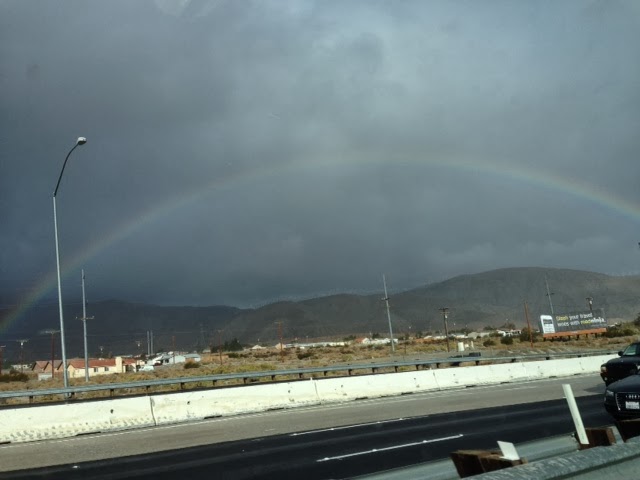
On the drive home we saw a full rainbow... in the desert. It was raining hard and the wind was blowing hard. In about a half hour this weather would reach La Qunita where it would hit athletes doing the full.


Sunday, December 1, 2013

Taper to First "A" Race - HITS Palm Springs Half Iron Triathlon

We're a little less than a week out from my last race of the season, which I have considered my "A" race - the race I have trained for this season. It is strange to think of this as a primary race, when I still consider it a warm up to the full Ironman in Cabo San Lucas. It is also strange to think of this as the last race of the season when it is only three and a half months until my next "A" race. However, it helps me to think that there is a break between the two so I can catch my breath and get ready for some more intense training volume.


While these things are strange to me, it is also fitting that The HITS Palm Springs Half Iron Triathlon be an "A" race, as it is my first attempt at this distance (half a full Ironman, at 1.2 mile swim, 56 mile bike, and a half marathon). It also happens at the beginning of December, right before Christmas, at which time I fully intend to briefly break away from my strict diet and indulge in the culinary delights of the holidays, including Christmas cookies, chocolate, and figgy pudding (whatever the heck that is, but I'm sure not leaving until I get some!). Moderation is key, of course, and as soon as Santa tucks himself in for his long Winter nap, I'll be back on course for my plan leading up to Cabo.

But back to this race. With less than one week to go, I am in full taper mode, and have been for about a week and a half now. I did a bit of a warm up at about the same distance on Thanksgiving day and felt really good. I can say at this point, barring any sickness or injury between now and then, that I am completely ready for this event.

The swim will take place in a reservoir, which will be a new experience for me since I've never swam in anyone's drinking water before. It's also quite possible that the water can be very cold. Last year it was in the high 50's. The bike and run will be very flat and at or below sea level, so it should be relatively easy to pace. The only challenges are that the weather and wind can be unpredictable. In the desert it could be very cold or very hot. I've planned for very hot, because I can always add layers if it gets cold. When the weather changes, so to does the wind, and it could be pretty brutal. We'll see how it shakes out.

It's amazing to think that after I finish this race, I am only a few short months away for the main event of this journey that I began almost a year ago. To think of where I came from and where I am now is amazing. I look forward to posting a race report next week, and beginning the next leg of this journey. Until then.